Saturday, 28 February 2015

Useful links for Information on job roles in the costume industry

As a student studying a BA Hons in Costume Design if is useful to know what sorts of career opportunities are available and link to help get into the industry. through my research i have complied a short list of useful website that might help others looking for similar information.

http://creativeskillset.org
Is a great site that gives you information an all sorts of roles and career opportunties in the the creative industry. In terms of costume  this full link:

http://creativeskillset.org/search/59?tags%5B%5D=&tags%5B%5D=Costume&q=

Provides Information on the following job roles

  • Costume Daily
  • Costume Assistant
  • Costume Design Assistant
  • Costume Designer
  • Costume Maker
  • Costume Supervisor 
  • Wardrobe Supervisor
Next up is the national careers service: https://nationalcareersservice.direct.gov.uk

This website provides in formation on a whole range of careers but for those looking for costume designer specific this link:
https://nationalcareersservice.direct.gov.uk/advice/planning/jobprofiles/Pages/costumedesigner.aspx
will provide the costume designer job profile page.  

Finally is a list of costume design companies or theatres where many previous students have took up work placements in order to gain experience in the Industry it is a good idea to contact these type of places if you are looking to get your first step into working in the costume industry. 

* but be aware most places will be unpaid work placement and not all may take on students for placement so it is best to check with individual companies but if you get in the door and show a keen interest and good skills then you may be offered paid work with them*

Links:


Wednesday, 28 January 2015

The Sherlock Holmes Museum - Baker St, London

While on a college trip to London i took the time to visit the Sherlock Holmes Museum in London. Over the years many TV series and Films have been made based on Sherlock Holmes and as a student of costume  design i felt it would be a nice stop off during my visit to london, as many items found at the museum would have been used to replicate props and costume accessories for those TV series and films. 

Below is a collection of items from the museum

Here we have a copy of a notebook or journal which at a time without mobiles and computers was one of the only ways of keeping records. 


Here you can see an early example of handcuffs which are clearly different from modern 21st century ones this is something to keep in main when researching and planning period costumes and accessories.


Here again is a few early examples of items a person might have like a hat and pipe, theatre glasses as there still was time for a social life among detective work.


Here are a couple of guns on display again different in appearance to those of the 21st century and another accessory that may need to be sourced to complete the look of a character or costume.


The last image is that of a writing desk as any good detective needs a base to work from again taking note of the various items arranged on the desk, these are the details that could make a production of a period TV or film a smash hit or a big flop. 


Images credited to

The Sherlock Holmes Museum
221b Baker Street, London NW1 6XE


The Harry Potter studios tour, London

While on my college trip to London among many of the places i visited like the V&A, and the Sherlock Holmes Museum I also when to the Harry Potter studios while there we were given special group talk in the academic learning centre, which is not part of the normal tour here we got to see up close some of the costumes and props used during the filming of harry potter before we proceeded onto the standard tour.

It was great to be able to take the tour looking at it through the eyes of a student costumier as you really can get a sense of what it would be like to work on such a big and long running movie production.

From this i would like to share just a small amount of the images i took while down there picking out the best and most relevant to those with an interest in the costume side of things.  


Top left we have a collection of Slytherin House uniforms
Top right we have a costume worn by Hagrid
Buttom left we have a costume worn by Professor Snape
Buttom right is a costume worn by Professor McGonagall


Here we have a collection of the wigs worn and made by many of the main cast.


More of the character costumes:
Top is potions teacher Professor Slughorn
Buttom is two costumes worn by Dolores Umbridge


Next up is a collection of the Death-Eater Masks


Here is a great piece of costume display, it shows how through the production of the movie many replications of the same costume had to be made showing different levels of wear and tear for many of the characters.  Here is one of Harry's which through various scenes in the movie harry would of encountered lots of wear and tear during battles with the dark side and this set of costume are displayed together to so this.   


Here we have some of the amazing work but the prosthetic and model makers that worked on the movies.

There is many more images i took while i was there too many to display but in the post i have tried to show off some of my favorites and those that show off some of the costumes for the main characters seen in the movies. 


The images are credited to

Warner Bros. Studio Tour London 
Studio Tour Drive
Leavesden
WD25 7LR

Tuesday, 13 January 2015

V&A Museum London

During a college trip to the capital in London i had the opportunity to visit many interesting places, one of those places was the Victoria & Albert  Museum. During this trip it allowed me to see some primary sources of research on costume and clothing from a wide time period. below are a few images with a bief description of what they are and when they are and the time period they date from.   

 Figure 1
Figure 2

Images figure 1 and 2 are are of a 1755-60 court dress viewed from the back.
This type of dress was required and the french court for all royal assemblies and balls.
Due to the shape and sheer  width of the dress it was a challenge to negotiate things like door ways and carriages while trying to maintain a level of gracefulness. 


 Figure 3
 Figure 4

Figure 3&4 features a ball dress  C.1820-25 made of silk satin and silk net embroidered with metal and silk bobbin lace.


 Figures 5 & 6

Figure 7

Figure 5-7 feature a Regency style day dress C.1817-20 comprised of a Spencer,skirt and bodice. figure 7 is a  tailcoat waistcoat and under-waistcoat C. 1815-20. 


Figure 8 & 9

Figure 8 is a printed wool dress C. 1835-38 while figure 9 is a doll for the same era C. 1830 note the similar style dress worn with large puffed sleeves and pleated skirt.


Figure 12

Figure 10-12 features the 1940-50s style tailored fit. Note how Figure 11 is a utility style ladies suit cut to minimise fabric wastage and the use of the 4 buttons was the maximum allowance under the clothes rationing regulation during war time Britain.

    
The V&A Japanese Armour section 


Figure 13- 16 are a selection of Japanese Samurai Armour popular ago the Edo period of Japan. 


Images credited to the Victoria and Albert Museum London
http://www.vam.ac.uk/


Saturday, 4 October 2014

Basic draping work


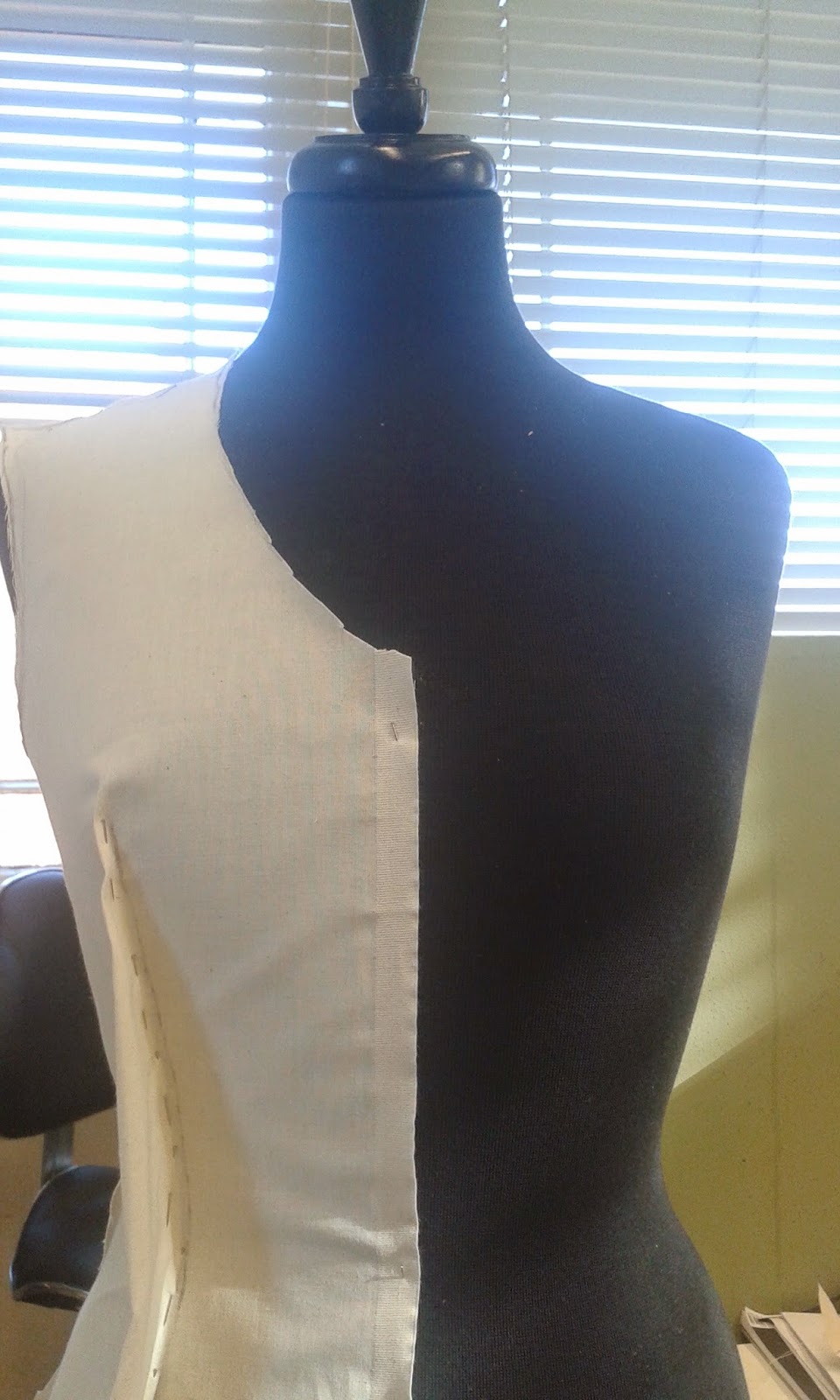
Prior to starting my BA Hons degree in costume i had never attempted to create garments and patterns by means of draping on the stand below are three images showing my first attempt at draping a basic bodice.

I found there to be both good and bad points to draping, one of the good points was that it gives you more creative freedom to create your own shapes and style. 

The down side to this i found was you can only drape to the size of you tailors bust which would need to be sized up or down depending on the size you wanted to achieve. 
All in all it is a technique i would like you work more with and i expect i will throughout my degree and beyond.   


Tuesday, 30 September 2014

My trip to Bowes Museum September 2014


Back in September 2014 when i first started on the costume degree course at CCAD we took a trip to Bowes Museum at Barnard Castle but it was only later as i have progressed through the course that i have come to realise what a fabulous source of primary research this museum really is most notable their fashion section which displays a wide verity on fashion clothing through the centuries. in this post i have tried to put together a selection of pictures i had took while there.


Figure 1

Above figure 1 is the exterior of the museum it is housed in a large French design styled Victorian house the collection and the museum was collected but John & Joséphine Bowes and contains a vast collection of art work and artifacts. 

The images up loaded are mainly from the the fashion and costume collection housed at Bowes.

 Figure 2
 Figure 3
 Figure 4
 Figure 5
Figure 6

Figure 2-5 are depict a Victorian dress from 1863. It features a gored skirts over crinoline at the time this coat style dress was extremely fashionable. it was worn by Lady Hutt  the wife of John Bowes stepfather for the royal wedding of the then Prince of wales and Princess Alexandra of Denmark.

 Figure 7
 Figure 8
Figure 9

Figure 7 - 9 features a 1868  green silk walking dress

 Figure 10
 Figure 11

Figure 10-11 features a young boys dress, it was not uncommon for a male child to be put in a dress during the early years of childhood.

Figure 12 

Figure 12 is a Mans corset C.1840 at this time it was fashionable for both men and women to have a thin waistline as a result the use or need for a mans corset came about this corset By Henry Adcock features;Cotton sateen, linen canvas, suede leather lien twill tape, cording, metal springs, whalebone.

the corset has 36 metal springs for elasticity, it is laced up at the centre back and sides to allow for adjustment over the hips, also it features a buttoned up front to allow it to be put on or taken off without needing to adjust the lacing. 


Images credited to Bowes Museum
Newgate, Barnard Castle, County Durham DL12 8NP